.jpg)
Leadership teams rarely fail for lack of resources or ambition. The issue is that by the time a decision reaches someone who can act on it, the signal that triggered it is weeks old and barely resembles what actually happened.
McKinsey finds that executives spend nearly 40% of their time preparing or making decisions — and consider most of that time poorly used. Companies that make fast, good decisions are twice as likely to outperform their peers financially.
Speed and quality reinforce each other. What kills both is how most large organizations move information.
In this piece, I want to explain why this keeps happening, what we call the fragmentation tax, and what leading organizations are doing differently — including what we've learned building context layers with enterprise teams at Workpath.
The root cause: how information travels in large organizations
Research in cognitive psychology shows that raw intelligence — what an IQ test actually measures — accounts for roughly 25% of real-world job performance. The rest comes down to context: how well someone understands the situation they're working in.
Performance = Intelligence × Context
Boardrooms aren't short on intelligence. And as LLMs get more capable, raw AI horsepower will be a commodity available to most companies. The real question is what context you're feeding your leaders and your AI models.
Data is everywhere in large organizations. The problem is that it's fragmented, disconnected, and moves through humans. By the time it reaches someone who can act on it, it has already been filtered, summarized, and quietly changed. Fast, accurate decisions don't get made on information like that.
Strategy lives in a deck, KPIs in Power BI, goals scattered across Excel files and Confluence pages. Initiatives are tracked in Jira, MS Planner, and a dozen separate review calls. When a signal emerges, a KPI deteriorating, a goal off-track, a market shift, it doesn't travel directly to the person who needs to act. It travels upward through reporting lines, gets compiled into a slide, discussed in a quarterly business review, and finally reaches a decision-maker weeks or sometimes months after the original signal.
Every crossing between tools, every meeting where information is manually reconciled, every summary written by a human who had to first read, digest, and translate: each is a delay. Each is a distortion. We call it the fragmentation tax.
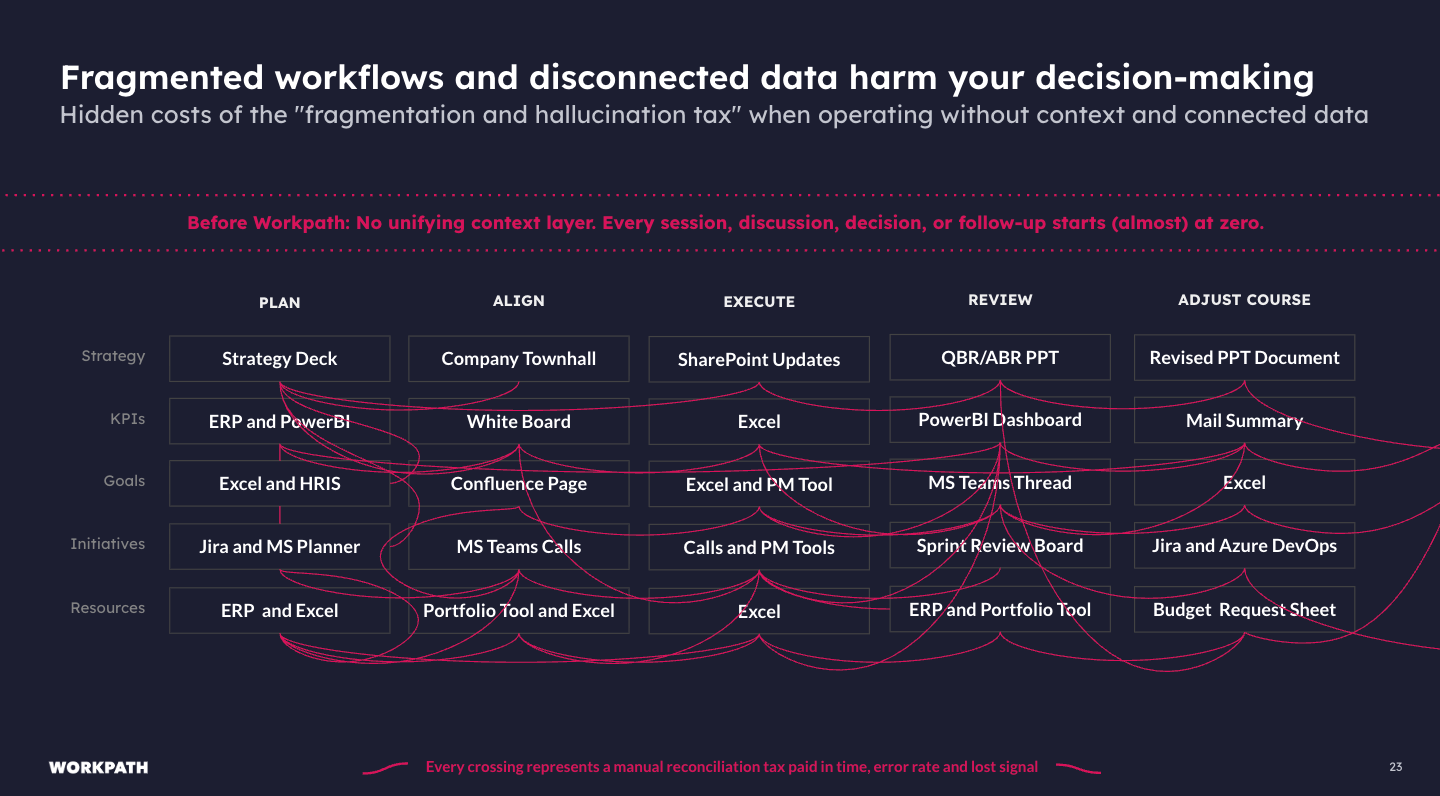
Hierarchical reporting was designed to compress information for senior decision-makers. That was the point. But compression means loss, and it creates room for manipulation and local optimization that nobody at the top ever sees.
More AI spending won't fix the fragmentation tax
In 2026, this still needs to be said: the fragmentation problem won't be fixed by more AI spending. That misconception is probably the main reason so many executives are disappointed with their return on AI so far. Like every previous wave of digitization, getting AI to actually work turns out to be as much about data, governance, and people as it is about the technology.
While everyone in tech is talking about enabling the "enterprise context layer," leading companies are already moving toward a fundamentally different architecture for how information flows in their organizations.
The context layer: a more evolutionary approach
I regularly meet managers who feel stuck in this process. Some are tired of consultants pushing radical restructuring concepts — Jack Dorsey’s “From Hierarchy to Intelligence” reads even more utopian to the average corporate than Holacracy did a few years ago. Others are still mid-way through an eight-year cloud transformation, and the prospect of yet another data architecture target state from a Gartner map is daunting.
But for enterprises to succeed in that context (pun intended), there are more evolutionary approaches that work. We've seen leadership teams gain real traction by breaking the context layer into smaller units, prioritizing by the use cases they most urgently needed to address and how independently each piece could be built.
So while the goal is a living representation of the entire organization's information, starting with smaller islands that enable strong use cases — from context data through to actual workflow — is a legitimate approach. This way, more complex and centrally driven building blocks (like a global metrics or data object library) stay out of your critical path, and further components can be layered in over time.
What this looks like in practice
At Workpath, we focus on better decision-making in strategy execution and business steering - which means, the kind of context we need to provide to teams within their operating rhythms is initially centered around strategy, goals, KPIs, initiatives, and their interdependencies. Consciously structuring these data points into a model, for example by connecting input-output-outcome-impact chains, quickly provides better answers to executives and more reliable AI use cases.
Dashboards may still be one output of a growing context layer, but the underlying core is far more powerful: a structured, machine-readable, continuously updated model of what the organization is trying to achieve and what is actually happening.
AI that understands the structure of goals can detect when a pattern breaks long before any human compiles a report. It surfaces decisions, routes them to the right person with the right context, and registers when action is taken. AI recommends, humans decide and override, and every decision makes the context layer a little more accurate.
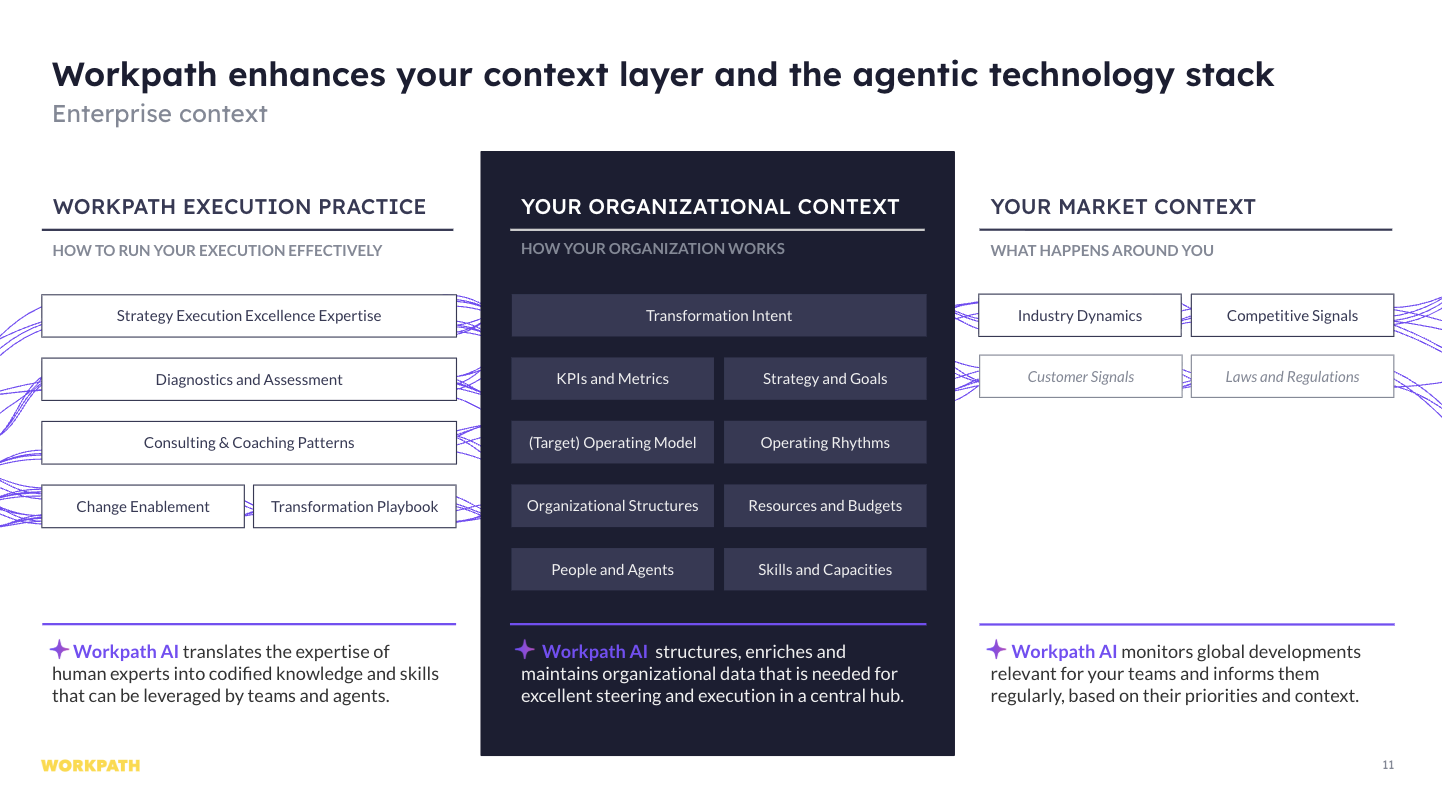
Once the basic architecture of your initial context layer is defined, including quality criteria, this is where you set intent and make sure your data model "has an opinion." AI can then help structure and improve data within that framework: suggesting missing KPI driver tree connections or flagging information gaps to the respective owner.
The cultural shift is the hardest part
The most culturally challenging step is eliminating the routines where humans are the main information pipe. Status meetings where nothing gets decided. Weekly updates compiled by someone just to be read by someone else. Reporting cycles whose only function is moving information from one person's head to another's calendar slot.
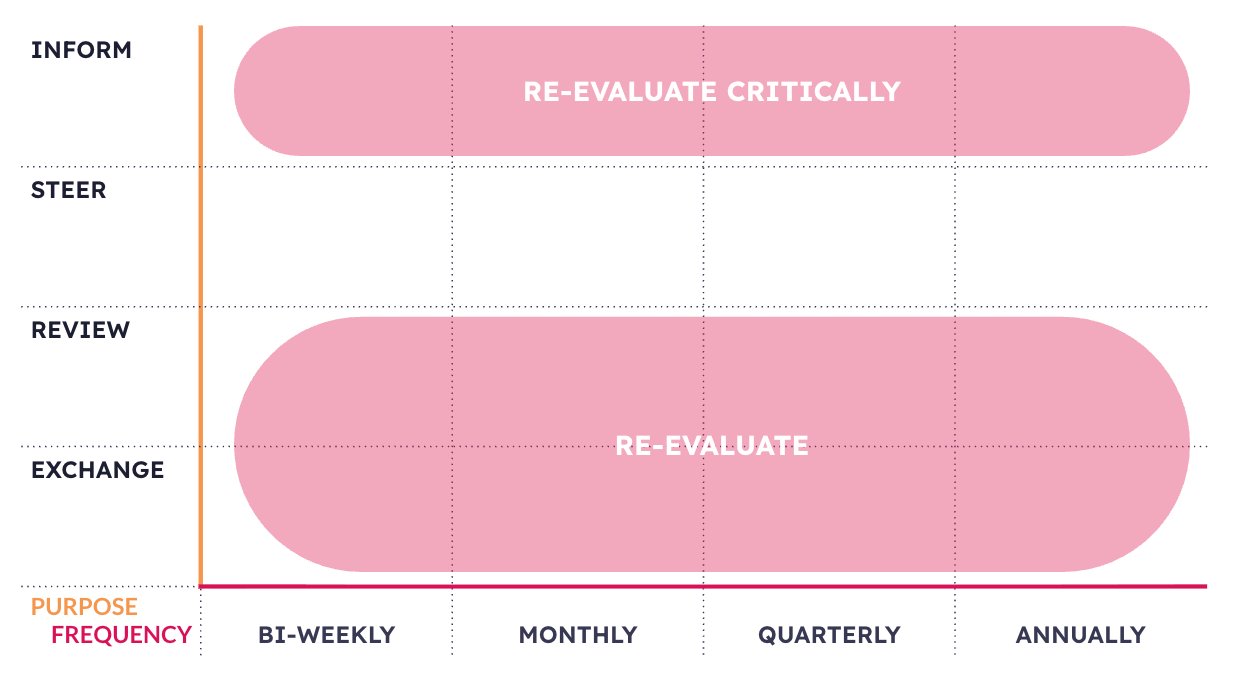
As Christoph Bornschein explained in a recent You&AI podcast episode with me, the future is "direct-to-context." Decision-makers stop waiting for information to reach them through hierarchies and meetings. They are instead permanently and directly connected to the signals that matter.
This requires governance as much as technology. It means being deliberate about what belongs in the context layer, who is accountable for keeping it accurate, and which decisions happen inside it versus outside it. Impact chains need to be mapped and maintained. AI outputs need to be auditable. Leaders who remove information-relay work from humans free up management capacity for things that actually require judgment.
Organizations that close the gap between signal and action will build a compounding advantage over time. Those that don't will keep paying the fragmentation tax: delayed decisions, wasted management time, and a strategy that drifts further from reality with every reporting cycle.
.avif)
.jpg)