.jpg)
Most enterprises have upgraded their AI stack at least once this year. Few can point to the business impact of these changes. That gap is worth taking seriously, because the usual explanation (that the models are not good enough) is rarely right. The constraint on enterprise AI has moved from intelligence to context, and most organizations do not yet have a working definition of what context data their AI applications need, let alone a plan to close the gap. This piece looks at what that gap looks like in practice, why the tools most companies already have fall short, and what would actually close it instead.
The AI adoption paradox
AI models have become far more capable over the last year. Stanford's 2026 AI Index Report puts numbers on it: on Terminal-Bench, which tests whether an AI agent can complete a real, end-to-end technical task without human guidance, accuracy rose from 20% in February 2025 to 77.3% in early 2026.
Business results are lagging far behind those gains. According to PwC's 2026 Global CEO Survey of 4,454 CEOs across 95 countries, 56% have seen no significant financial benefit from AI to date, and only 12% report gains on both cost and revenue. The same survey also shows what sets that group apart: CEOs whose companies have strong foundations in place are three times more likely to report meaningful financial returns.
Many organizations do see returns in individual teams and use cases. Those returns have simply not met the expectations set when the investments were made.
The bottom line: AI is getting smarter. So why are smarter models not producing better results?
The missing variable for AI success
For most of the last decade, the bottleneck in enterprise software was how systems could work with data. Software was deterministic: every workflow had to be defined in advance as an if-this-then-that rule, written by hand. Whenever a situation required judgment, such as interpreting an ambiguous request, weighing two conflicting priorities, or handling an exception no rule anticipated, the system stopped and a person had to step in.
Making those judgment calls is what intelligence does in an enterprise, and that capability is no longer scarce. According to Stanford's 2025 AI Index, the cost of querying a model that performs at GPT-3.5 level fell more than 280-fold between late 2022 and late 2024, and most enterprises can now license frontier models through the cloud providers they already work with. Security reviews, compliance and integration still take real effort, but access to capable reasoning is no longer what separates one company from another.
That moves the bottleneck from intelligence to context. AI can now make judgment calls, but every judgment is only as good as what it is based on. Structured, reliable data has always been a challenge for large organizations. What is new is that it now decides whether a company gets the full value out of AI, and with it, how competitive that company is.
$$WHAT IS CONTEXT IN ENTERPRISE AI?
Enterprise context is the business-specific meaning an AI model does not have on its own: what your terms mean, who owns what, which rules apply and what is true right now. Models start every request from zero. They know nothing about your org chart, your metric definitions or the policy that changed last quarter.
The context layer supplies that meaning. It is the governed infrastructure between a company's data and systems on one side and its AI models and agents on the other. It typically covers:
- Definitions: agreed meanings and the relationships between them (an ontology), so that "active customer" or "at risk" means the same thing everywhere.
- Ownership: who is accountable for which goal, KPI, initiative and decision.
- Rules and intent: policies, decision rights, the exceptions currently in effect, and the strategic priorities behind them.
- Current state: reliable, structured data on where things stand, plus a record of recent events, decisions, actions and outcomes.
- Connections and AI legibility: links across CRM, ERP, data warehouse and project tools, in a form agents can query instead of buried in slide decks and wikis.
Increasingly, this is referred to as the "company brain": a living model of how an organization works and what it is trying to achieve. The term is still new, and vendors define it differently. For some it means metric logic, for others entity relationships or document search. Workpath focuses on steering and execution: goals, KPIs, initiatives, resources and ownership, and the intent behind them, kept current through the operating rhythm.$$
Intelligence and context multiply each other: performance = intelligence × context.
A brilliant model reasoning over fragmented or missing context produces a confidently wrong answer, faster and at a scale no team could match on its own. When context is close to zero, no amount of intelligence makes up for it. While enterprises depend on both context and intelligence, most organizations still operate under low-context conditions.
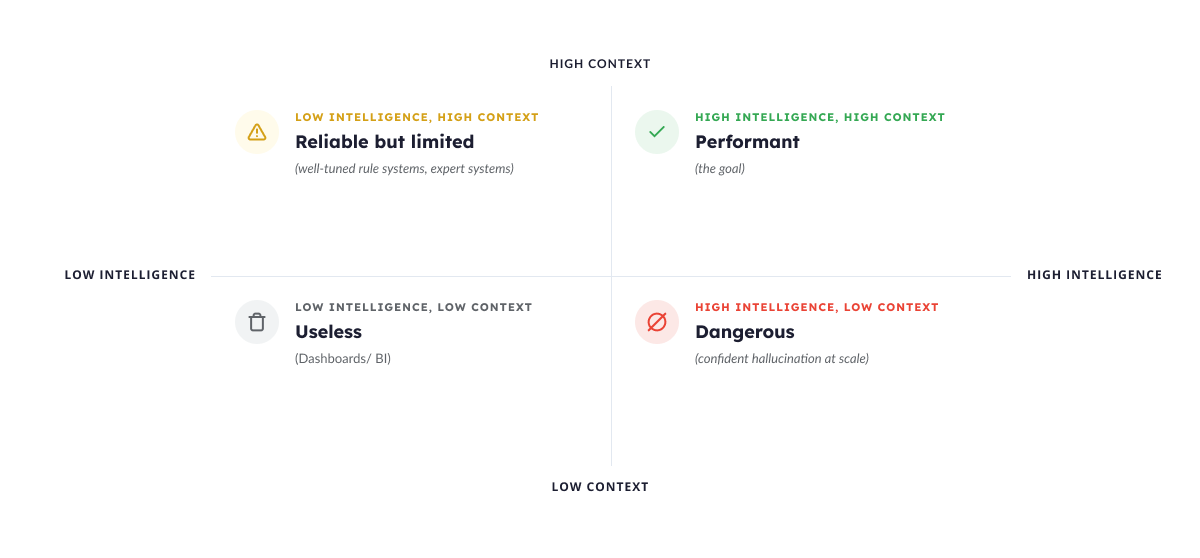
- Low intelligence, low context is the dashboard era. Static reports, fixed queries, dependable for exactly what they were built to check, and blind to anything outside that scope.
- Low intelligence, high context is the rules-engine era. The logic is right and applied consistently, but the system cannot reason past the rules it was given. Every new situation, every edge case nobody anticipated, requires a human to extend the system.
- High intelligence, low context is where most enterprise AI sits today. The model is capable, but it has no idea what "active customer" means at your company, or which definition of revenue your finance team uses. The output sounds confident and fluent, but it is often inaccurate or vague, and that combination is what makes this quadrant dangerous: people act on a mistake that sounds this sure of itself before anyone thinks to question it.
- High intelligence, high context is the target: an agent that reasons well and knows your business. Few organizations operate here consistently yet.
The context problem itself is not new. Enterprises have spent two decades building context: data catalogs, business glossaries, wikis, master data management programs meant to reconcile the fact that the CRM, the ERP, and the data warehouse each have their own idea of who a customer is.
However, none of it was built with today’s AI capabilities in mind, and that is where these systems fall short. A glossary entry sitting in a wiki is static: it only changes when someone remembers to update it, and until someone does, the definition inside it quietly goes stale. An AI agent pulling from it inherits that stale answer without knowing it is outdated. A model reasoning about your business in real time needs a live context layer to answer accurately, not a snapshot from months ago. This is the gap most enterprise AI programs still have to close.
The context gap most organizations are built on
Here is how many organizations still use AI today, and how you can evaluate your own context maturity.
Ask an AI agent which initiatives are at risk this quarter and why. A capable model will answer immediately, usually with something plausible. Then ask these follow-up questions: did it use your organization's actual threshold for "at risk," did it know who currently owns each initiative, and did it check which exceptions to the plan are still in effect? In most companies, the answer is no to most of those. The agent applied a generic definition of "at risk," that may differ from your organization’s. It named an owner from an org chart that is two reorgs out of date, or no owner at all. It applied a rule your team quietly stopped enforcing eight months ago. The model filled a gap it did not know existed with its best guess.
As Workpath CEO Johannes Etzelmüller argued in his article on The Fragmentation Tax, fragmented information slows decisions down. For AI, the consequence is more direct: fragmented information leaves AI without what it needs to reason accurately. A slow decision costs time; a confidently wrong one from an agent that did not know what it was missing costs a lot more.
Enterprise AI roadmaps are built around swapping in the next model and expecting performance to follow. Whatever comes after today's frontier models will still not know your governance structure, your KPI definitions, or your approval chains until someone gives it that information directly.
Closing the gap, and what is actually at stake
Most large organizations are already working on this. The open question is how to build that context, govern it and keep it current. And in corporate IT, few expect that to happen in one central system. Context will live across data platforms, catalogs, CRM and ERP systems, knowledge graphs and specialist tools, each owning part of the picture.
Workpath's context management solution is one part of that landscape, with a specific role: it is where rationale and intent live, and where data signals are translated into the right, measurable initiatives that help achieve a target. It filters, structures and orchestrates context through the lens of the organization's strategy and priorities.
Unlike a glossary or a catalog, it organizes an ontology of the data an organization needs for its most relevant steering decisions: goals, KPIs, initiatives, dependencies and ownership, but also operating rhythms, organizational structures, resources and budgets, people and agents, and the intent behind a transformation. That context is kept current because it is built directly into the operating rhythm where those things already get decided: QBRs, MBRs and check-ins. When a target changes in the room, it changes in the context. When an owner moves on, ownership updates with them.
Market signals and codified execution practice sit alongside this organizational context. Together, they give humans and agents the same picture to work from, which is what makes human and agent collaboration possible inside a codified operating model.
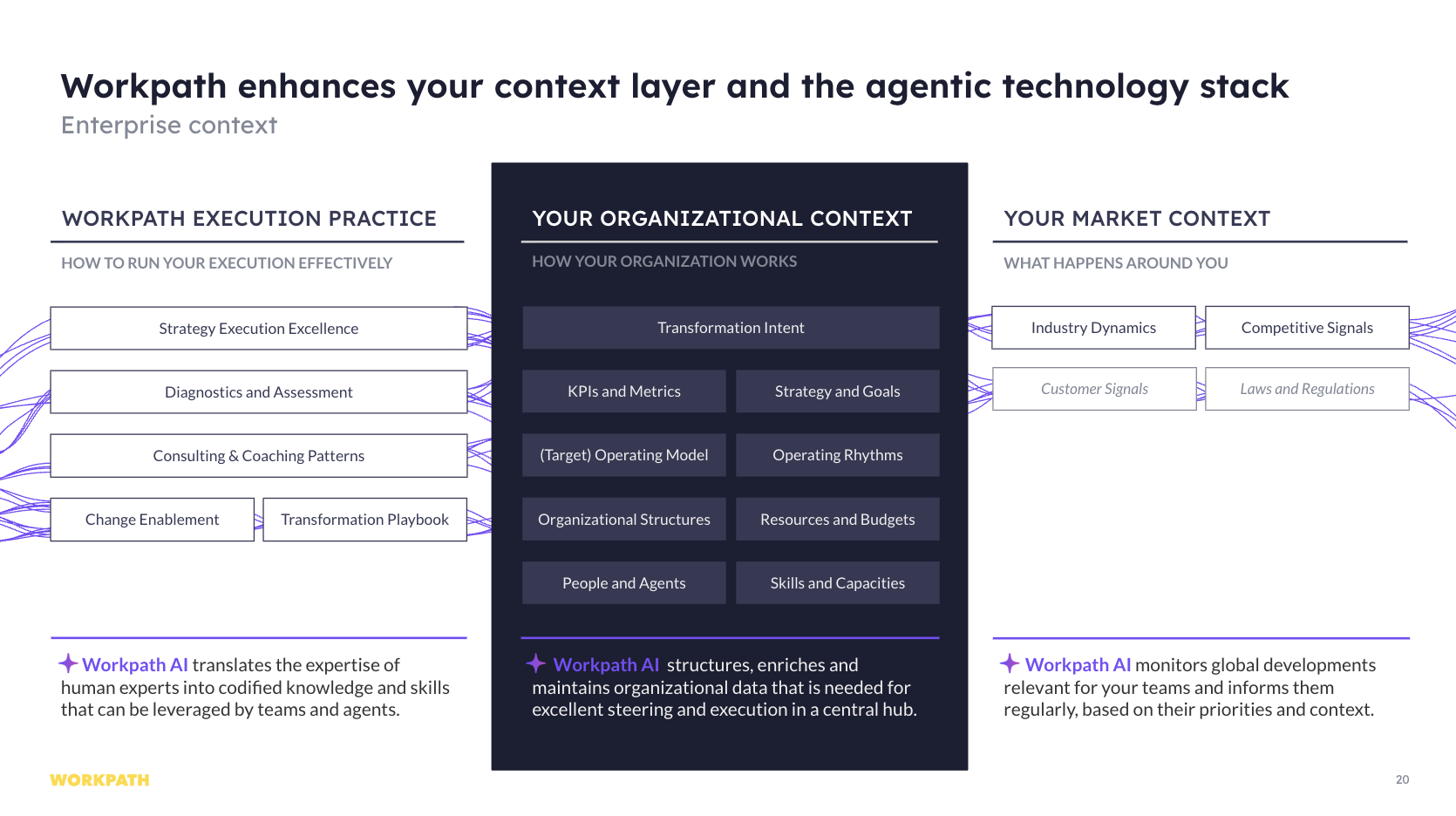
The future context layer of an enterprise, organized around Workpath's context management, enables AI to play to its full strengths: augmenting management and automating operative work. AI no longer works off a definition someone wrote down once, but from context it can rely on every time. It can catch a conflicting objective between two teams before it turns into a resourcing fight, flag a goal whose progress has quietly gone stale, and surface it to the person who actually owns it.
Any agent connected to that context, whether Workpath's AI Companion or another agent in your stack, can come to you when it identifies a risk, long before you know you want to ask. When you do ask which initiatives are at risk, the answer pulls your threshold, your current owner and your live exceptions straight from the place where your team already tracks them.
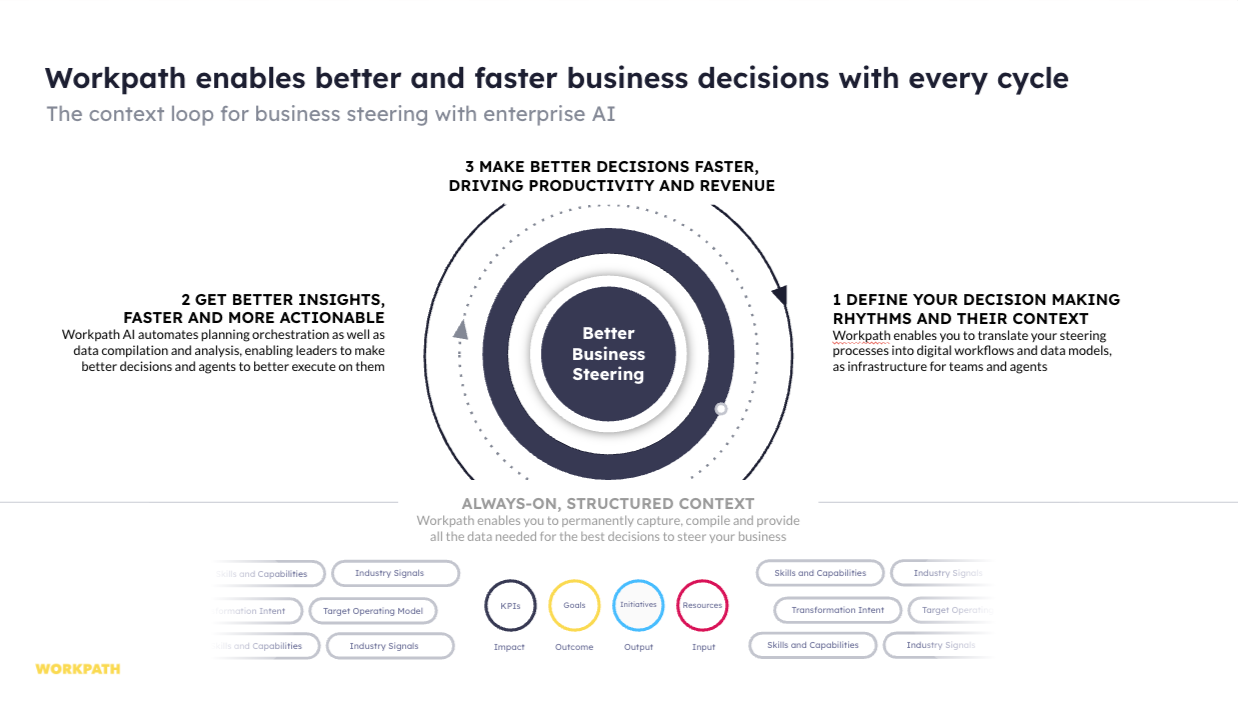
The first phase of enterprise AI was a race for adoption: roll out copilots, bring in agents, get every team using AI. That race is over. Capable models are widely available, at prices that will most likely keep falling for intelligence that is good enough for most use cases. The differentiator from here is how well an organization has codified the way it actually operates into context a model can reason over. Goals, KPIs and ownership are part of that, but so are operating rhythms, organizational structures, resources, decision rights, transformation intent and the market signals around the business.
.jpg)